
SEO
Cloud Computing vs. On-Premise Infrastructure: Which Is Right for Your Business?
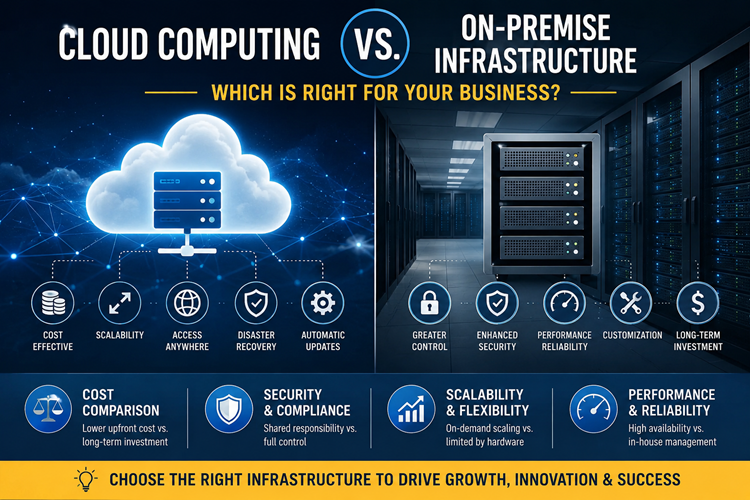
Jul
At some point, almost every growing company ends up in the same meeting: someone on the finance team asks why the AWS bill keeps climbing, someone on the engineering side mutters about wanting more control over the servers, and somebody else asks the question nobody has a quick answer to- should we even be in the cloud, or would we be better off running this ourselves?
It’s a fair question and it doesn’t have a tidy answer. Cloud computing has become the default assumption for a lot of businesses over the past decade, to the point where “on-premise” almost sounds old-fashioned. But old-fashioned isn’t the same as wrong. Plenty of companies, including some very large, very modern ones still run critical systems on their own hardware and for good reasons. The right answer depends less on what’s trendy and more on how your business actually operates.
First, what are we even comparing?
Cloud computing means you’re renting infrastructure- servers, storage, networking- from a provider like AWS, Microsoft Azure, or Google Cloud and you access it over the internet. You pay based on usage, the provider handles the physical hardware and you can dial capacity up or down without buying a single piece of equipment.
On-premise means the opposite, you own the servers, you own the data center or server room they sit in and your own IT team is responsible for keeping the lights on- literally and figuratively. Patching, cooling, power redundancy, and hardware replacement all of it falls on you.
Most companies today don’t pick one and ignore the other entirely. Hybrid setups have become common enough that it’s worth keeping in the back of your mind as you read through the rest of this.
The money conversation nobody enjoys having
On-premise costs a lot up front. Servers, storage arrays, networking gear, the physical space to put it all in that’s real capital spent before you’ve run a single workload and it depreciates. Every few years, you’re looking at another round of hardware refreshes whether you want to or not.
Cloud flips that around. There’s little or nothing to buy up front, you’re paying a monthly or usage-based bill instead. That’s appealing when cash flow matters, which is most of the time for most businesses. But here’s the part people don’t always expect: cloud bills have a habit of creeping upward in ways that are hard to predict. A server nobody remembered to shut down. A storage tier nobody optimized. Teams are provisioning more than they need because it’s easier than asking for a budget increase later. None of that shows up in the sales pitch.
So, the honest version is this: if your workloads are steady and predictable and you’re planning to run them for years, owning the hardware outright is often the cheaper path in the long run. If your needs are variable, or you’re not sure yet how much capacity you’ll actually need, the cloud’s pay-as-you-go model avoids locking up capital in equipment that might sit half-idle.
Scaling up and down
This is probably the cloud’s clearest advantage. If your traffic spikes for a product launch, or you suddenly need to crunch a huge dataset, you can add capacity in minutes and let it go just as fast once you’re done. There’s no procurement cycle, no waiting on a shipment of servers.
On-premise scaling looks nothing like that. Buying, racking and configuring new hardware takes real time- weeks, sometimes months. If your growth is slow and predictable, that’s not a huge problem. If you need to move fast, it can be a genuine bottleneck.
Security and who’s actually watching the door
People sometimes assume on-premise is automatically more secure because “it’s all under our roof.” That’s not quite right, but the instinct isn’t crazy either. Keeping everything in-house does give you full physical control, and for companies with strict data residency rules- certain government contracts, some healthcare and financial regulations- that direct control can make compliance simpler because fewer parties are involved.
Cloud providers, meanwhile, pour enormous resources into security that most individual companies simply couldn’t replicate- dedicated threat-detection teams, redundant facilities, a long list of compliance certifications. The catch is what’s sometimes called the shared responsibility model: the provider secures the infrastructure itself, but you’re still on the hook for configuring access controls and encryption correctly and in practice, most cloud security failures trace back to misconfiguration, not some flaw in the platform. The tool isn’t the weak point. Whoever set it up in a hurry usually is.
Neither option wins outright here. It’s really a question of whether you’d rather own the risk directly or share it with a provider and whether your team has the discipline to configure things properly either way.
Who’s stuck doing the maintenance
Running your own servers means your IT team owns everything- every patch, every failed hard drive, every capacity planning spreadsheet. That’s time and expertise that isn’t going toward the actual product.
With cloud, the provider takes on the infrastructure maintenance, which frees your team up to focus on the stuff that’s closer to the business itself. For a smaller company without a dedicated ops team, this alone is often reason enough to lean cloud.
Reliability and what happens when something breaks
Big cloud providers run redundant data centers across multiple regions and back that up with strong uptime guarantees- if one location has a problem, workloads can often shift elsewhere automatically. Building that kind of resilience on your own is possible, but it’s expensive: backup power, a secondary physical site, redundant everything. Doable, just not cheap.
Where on-premises still earns its keep
Despite everything pulling companies toward the cloud, there are situations where keeping infrastructure in-house is still the right call:
- You’re in a regulated industry with strict data residency requirements
- Your workloads are steady enough that the cloud’s flexible pricing doesn’t buy you much
- You’re running latency-sensitive applications that need to sit physically close to users or equipment
- You’ve already got infrastructure with useful life left in it
- You genuinely have the in-house expertise to run it well
Where cloud tends to make more sense
And the flip side- cloud usually wins when:
- Demand is unpredictable and you need to scale quickly
- You want to avoid tying up capital in hardware
- Your team is small, or your infrastructure just isn’t your core expertise
- You need a global footprint without building data centers everywhere
- Speed to market matters more than squeezing out the lowest possible long-term cost
The middle path most companies actually land on
In practice, a lot of businesses don’t choose one side cleanly. They keep the sensitive or latency-critical stuff on-premise and push the more variable, growth-driven workloads to the cloud. It’s more work to manage two environments instead of one, but it lets a company keep tight control where it matters most while still getting the flexibility of the cloud everywhere else.
What the market data actually shows
This isn’t just a theoretical debate- it shows up clearly in industry research. According to Consegic Business Intelligence, hybrid deployments already account for the largest share of spending across several cloud-adjacent markets. In cloud high-performance computing specifically, hybrid setups captured more than half of segment revenue in 2023, a pretty strong signal that businesses aren’t picking cloud or on-premise so much as architecting around both at once.
The private cloud market alone was valued at around $130 billion in 2024 and is on track to more than double by 2032, growing at a double-digit rate every year. Telecom, finance and healthcare are driving a lot of that- industries that need cloud-level flexibility but can’t fully let go of the control a dedicated environment provides. That same research also flags high upfront implementation and maintenance costs as one of the biggest obstacles to private cloud adoption, especially for smaller businesses- which lines up exactly with the capital-versus-operating-expense tension described earlier.
What’s easy to miss is that on-premise hasn’t quietly disappeared in the shadow of all this cloud growth. In markets like cognitive computing, on-premise deployment actually held the largest revenue share as of 2024, with companies pointing to disaster recovery, customization and sustainability goals as reasons for keeping certain workloads in-house. It’s a good reminder that this isn’t a one-time decision- it’s an ongoing one, revisited workload by workload.
So how do you actually decide?
Before committing to a direction, it’s worth being honest with yourself about a few things.
How predictable is your workload, really? Steady and forecastable leans on-premise. Spiky and uncertain leans cloud. What do your compliance obligations actually require? Sometimes the industry or the jurisdiction makes this decision for you before cost ever enters the conversation. Do you have more capital to spend up front, or more room in your monthly budget? That distinction matters more than people expect. Does your team actually have the skills to run infrastructure well? If not, a managed cloud environment removes a lot of that burden and how fast do you genuinely need to move? If speed is the priority, the cloud’s elasticity is hard to match with owned hardware.
There are no bonus points for picking whichever option sounds more modern. The right call is the one that fits your actual workloads, your compliance picture, your budget shape and what your team can realistically manage and for a lot of businesses, that ends up being some version of both, not an either/or.
